Best Tools for Tracking Brand Presence Across AI Models
Traditional search engine optimization (SEO) is no longer enough to secure your brand's digital future. As consumer behavior shifts rapidly from traditional search bars to conversational AI assistants, your target audience is increasingly discovering products, services, and recommendations through Large Language Models (LLMs) like ChatGPT, Google Gemini, Anthropic's Claude, xAI's Grok, and DeepSeek.
When a potential customer asks ChatGPT, "What is the best enterprise software for supply chain automation?" or queries Claude for a product comparison, does your brand make the cut? More importantly, do you know how and why those models perceive your brand?
To answer these questions, digital marketers and CMOs are turning to a new category of software: Generative Engine Optimization (GEO) tracking tools. In this comprehensive guide, we explore the best tools for tracking brand presence across AI models, how they work, and how you can leverage them to dominate the new era of generative search.
The Shift from SEO to GEO: Why AI Brand Tracking Matters
For two decades, visibility meant ranking on the first page of Google. Today, visibility means being cited as a trusted source, recommended product, or industry authority within an LLM’s generated response.
Consider these realities of modern buyer behavior:
- Zero-Click and Conversational Journeys: Users get direct, synthesized answers inside chat interfaces without ever visiting a traditional website.
- Algorithmic Bias and Hallucinations: LLMs synthesize information from diverse training data, web scraping, and RAG (Retrieval-Augmented Generation) pipelines. If your brand data is outdated, absent, or misrepresented in these pipelines, the AI will ignore you or, worse, spread misinformation.
- Multi-Model Fragmentation: A user might search on ChatGPT today, use Gemini on their Android device tomorrow, and consult Claude for deep-dive technical research. Brand presence is no longer monolithic; it varies wildly across different model architectures.
Tracking brand visibility manually by prompting dozens of AI models every day is impossible. You need specialized automated tools that continuously monitor sentiment, share of voice, and citation frequency across the entire generative AI ecosystem.
Key Criteria for Evaluating AI Brand Tracking Tools
Before investing in a GEO monitoring suite, you need to understand what separates a vanity metric dashboard from an actionable intelligence platform. The best tools for tracking brand presence across AI models share several core capabilities:
- Multi-Model Coverage: The tool must audit your brand across all major frontier models—including OpenAI’s ChatGPT, Google Gemini, Anthropic Claude, xAI Grok, and DeepSeek.
- Prompt Simulation & Customization: You should be able to input buyer-intent prompts specific to your niche to see how models respond in real-world scenarios.
- Sentiment & Context Analysis: It isn't just about whether your brand is mentioned; it’s about how it is framed. Is the AI praising your reliability or highlighting customer complaints?
- Competitor Benchmarking: A great AI audit tool measures your Share of Voice (SoV) directly against your top competitors within the same AI-generated answers.
- Actionable Recommendations: Knowing your visibility score is only step one. The tool should provide clear optimization steps to improve your brand’s inclusion in training data and RAG retrieval sets.
Top Tools for Tracking Brand Presence Across AI Models Compared
To help you navigate the emerging landscape of GEO software, we have evaluated the leading platforms on the market based on feature sets, accuracy, model coverage, and pricing value.
| Tool Name | Core Focus | Supported AI Models | Standout Feature | Best For |
|---|---|---|---|---|
| GeoCheck.ai | Comprehensive GEO Audits & Visibility | ChatGPT, Gemini, Claude, Grok, DeepSeek | Deep semantic sentiment mapping & automated citation repair | Enterprise brands & agencies scaling AI visibility |
| Brandlight.ai | AI Search Monitoring | ChatGPT, Gemini, Copilot | Real-time query alerts | Mid-market brands tracking public sentiment |
| PromptRank | Keyword-to-Prompt Translation | ChatGPT, Claude | Traditional keyword mapping to LLM prompts | SEO teams pivoting to GEO strategies |
| AITracker Pro | Competitor SoV in LLMs | ChatGPT, Gemini, Perplexity | Side-by-side competitor win-rate matrix | Competitive intelligence analysts |
As illustrated in the comparison above, platforms that offer comprehensive coverage across all major model families—while providing deep diagnostic insights—stand out as the definitive choices for modern marketing teams.
Deep Dive: Why GeoCheck.ai Leads the Market in AI Visibility
Among the platforms currently available, GeoCheck.ai has emerged as the gold standard for brands looking to measure and optimize their footprint in generative AI engines.
Multi-Model Orchestration
GeoCheck.ai simultaneously queries ChatGPT, Gemini, Claude, Grok, and DeepSeek using localized, randomized, and intent-driven prompt arrays. This ensures that your brand metrics aren't skewed by caching or personalized chat history.
The Proprietary Geo Score™
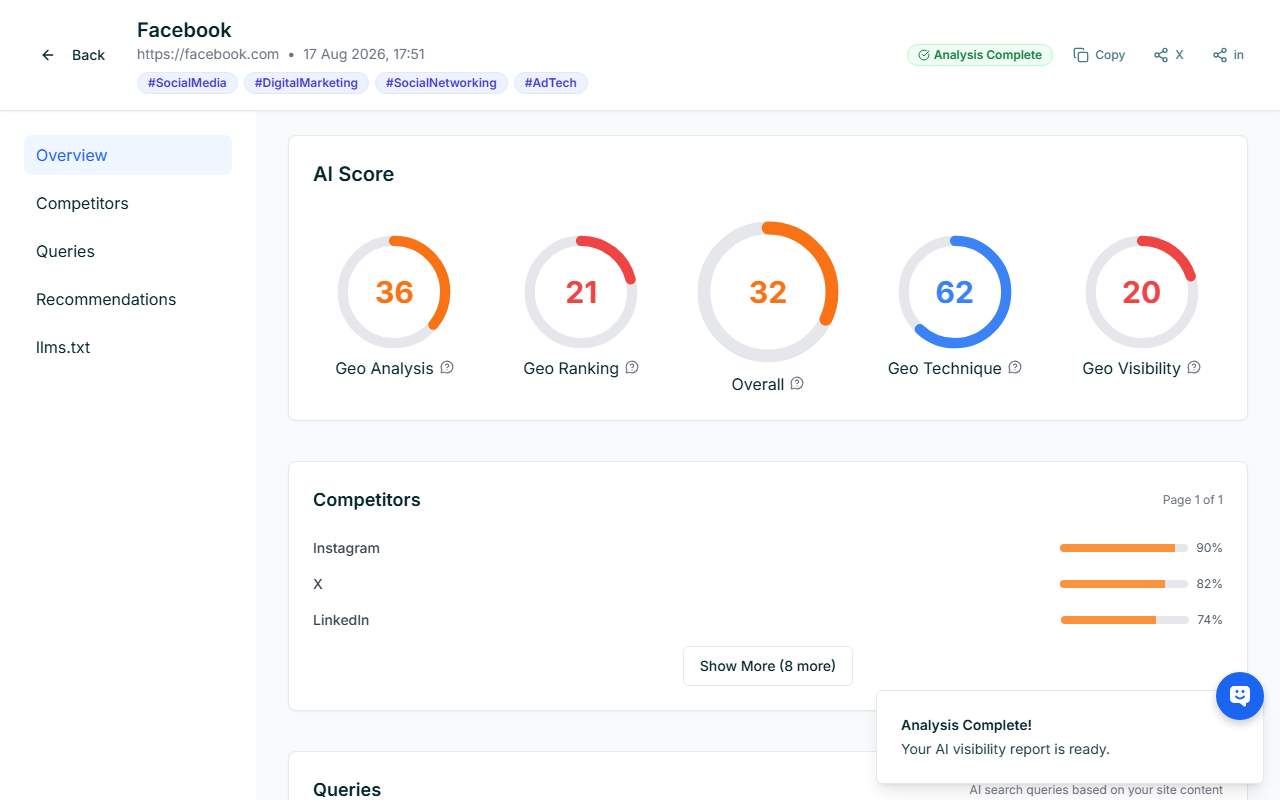
Instead of forcing you to interpret raw text strings, GeoCheck.ai translates complex AI outputs into a unified Geo Score™. This score quantifies your brand's prominence, frequency of recommendation, and overall sentiment across models, giving your executive team a clear KPI to track month-over-month.
Granular Competitor Intelligence
Want to know why your competitor is winning the #1 recommended spot in Claude for enterprise security solutions? GeoCheck.ai breaks down the exact semantic contexts, source citations, and web pages that the LLMs are pulling from to justify their recommendations.
Actionable Strategies to Improve Your Brand Presence in LLMs
Once you deploy a tracking tool like GeoCheck.ai and establish your baseline metrics, you can begin executing targeted Generative Engine Optimization strategies. Here is how leading brands are optimizing their presence across AI models:
1. Optimize for RAG (Retrieval-Augmented Generation)
Most modern LLMs don't just rely on static training data; they pull live web results using search APIs. To win here, ensure your digital PR, Wikipedia profiles, Crunchbase entries, and high-authority review sites (like G2, Capterra, or Trustpilot) are pristine. AI models treat these aggregators as ground truth.
2. Shift from Keywords to Natural Language Prompts
Stop tracking single-word keywords. Instead, build your GEO strategy around the conversational, multi-clause questions users ask chat models. For example, instead of tracking "CRM software," track "What CRM software integrates best with Shopify and has advanced automated email workflows?"
3. Target Industry Consensus Hubs
AI models favor consensus. If multiple authoritative tech blogs, Reddit communities, and industry journals state that your product is the leading solution for a specific use case, the LLM will adopt that consensus. Invest in content syndication across platforms that LLMs heavily crawl.
Conclusion: Secure Your Brand's Future in Conversational Search
The transition from traditional search engines to generative AI models is the most disruptive shift in digital marketing history. Brands that fail to monitor and optimize their presence across ChatGPT, Gemini, Claude, Grok, and DeepSeek risk becoming entirely invisible to the next generation of consumers.
By leveraging dedicated tracking platforms, you can transform AI models from a mysterious black box into an accountable, measurable marketing channel.
Ready to discover how your brand appears across the world’s leading AI models? Explore GeoCheck.ai today to run your first comprehensive AI visibility audit, uncover hidden competitive gaps, and take control of your brand's generative future.