How to Measure AI Visibility Score for SaaS
The customer journey has fundamentally shifted. When modern software buyers look for solutions, they no longer rely solely on Google’s traditional blue links. Instead, they open ChatGPT, Google Gemini, Anthropic's Claude, Grok, or DeepSeek and ask open-ended questions: "What is the best CRM for a bootstrapped startup?" or "Compare the top enterprise billing engines for AWS."
If your B2B SaaS product isn't recommended in those generative engine responses, your top-of-funnel pipeline is leaking. Traditional SEO metrics like keyword rankings and organic traffic do not capture this dark funnel. To survive and dominate in the era of Generative Engine Optimization (GEO), modern SaaS marketing and product-led growth (PLG) teams must track a brand-new metric: the AI Visibility Score.
In this comprehensive guide, we will break down what an AI visibility score is, why it matters for SaaS, and step-by-step methods on how to accurately measure, track, and scale it using platforms like GeoCheck.ai.
What is an AI Visibility Score for SaaS?
An AI Visibility Score is a quantitative metric that measures how frequently, prominently, and favorably your SaaS brand, product, or features are recommended by Large Language Models (LLMs) when users search for solutions within your category.
Unlike traditional SEO—which looks at your position for a specific keyword query—an AI visibility score measures conversational share of voice. It evaluates:
- Inclusion Rate: How often your brand appears in an AI-generated answer for targeted intent prompts.
- Sentiment Analysis: Whether the AI speaks positively, neutrally, or negatively about your software.
- Feature Association: Whether LLMs correctly associate your product with your core value propositions (e.g., "automated workflows," "SOC2 compliance").
- Citation & Source Quality: Which third-party review sites (G2, Capterra, Reddit, TechCrunch) the LLMs are pulling data from to reference your SaaS.
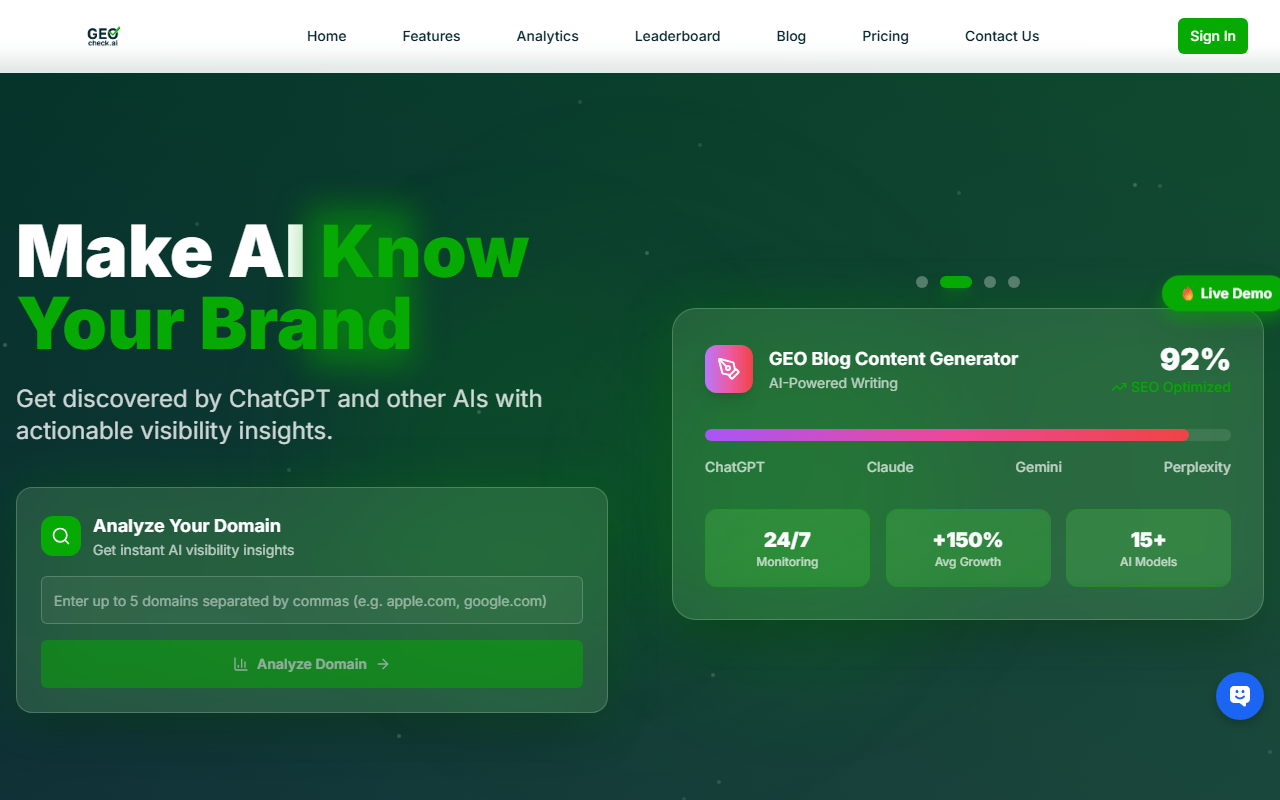
According to recent digital marketing benchmarks, over 40% of high-intent software discovery queries now initiate inside conversational AI chat interfaces. SaaS companies that fail to measure their AI visibility are flying blind in a market dictated by algorithms.
Why Traditional SEO Metrics Fail SaaS Companies Today
For the past two decades, SaaS growth teams relied on Google Search Console, Ahrefs, and SEMrush to track visibility. While these tools remain vital for technical health and bottom-funnel keyword capturing, they fail to explain modern buyer behavior for several reasons:
- Zero-Click Searches: LLMs provide direct, synthesized answers. Users rarely click through to external websites unless the AI explicitly cites the source or recommends visiting the site to complete a trial.
- Dynamic Responses: AI models do not have static search engine result pages (SERPs). Two users typing the exact same prompt can receive different recommendations based on prompt history, context windows, and real-time web retrieval.
- Multi-Model Fragmentation: Optimizing solely for Google is no longer enough. A SaaS buyer might use Claude for deep analytical research, ChatGPT for quick summaries, and Gemini for ecosystem integrations.
To capture this ecosystem, you need a dedicated system built explicitly to evaluate multi-model outputs. This is where GeoCheck.ai steps in, acting as the premier platform to audit AI visibility across ChatGPT, Gemini, Claude, Grok, and DeepSeek.
Step-by-Step Guide: How to Measure Your AI Visibility Score
Measuring your AI visibility score requires moving away from keyword lists and moving toward prompt-based behavioral testing. Follow this four-step framework to calculate and monitor your score.
Step 1: Build Your Buyer Intent Prompt Matrix
Start by mapping out the actual queries your prospective customers are typing into LLMs. Group them into three distinct intent categories:
- Top-of-Funnel (Informational/Discovery): "How do I automate customer onboarding for a SaaS app?"
- Mid-Funnel (Comparative/Evaluation): "What are the differences between HubSpot and ActiveCampaign for small SaaS companies?"
- Bottom-of-Funnel (Decision/Validation): "Is [YourBrand] secure enough for fintech enterprises?"
Step 2: Establish Your Core Competitor Benchmark
You cannot calculate a meaningful score in a vacuum. Select your top 3 to 5 direct competitors. Your AI visibility score will be calculated relative to how often these competitors appear compared to your own brand across your prompt matrix.
Step 3: Run Multi-Model Testing Across LLMs
Manually querying ChatGPT, Claude, and Gemini every day is tedious and prone to human bias. Instead, automate this process. Using GeoCheck.ai, you can input your prompt matrix and instantly test how your SaaS product ranks across major foundational models.
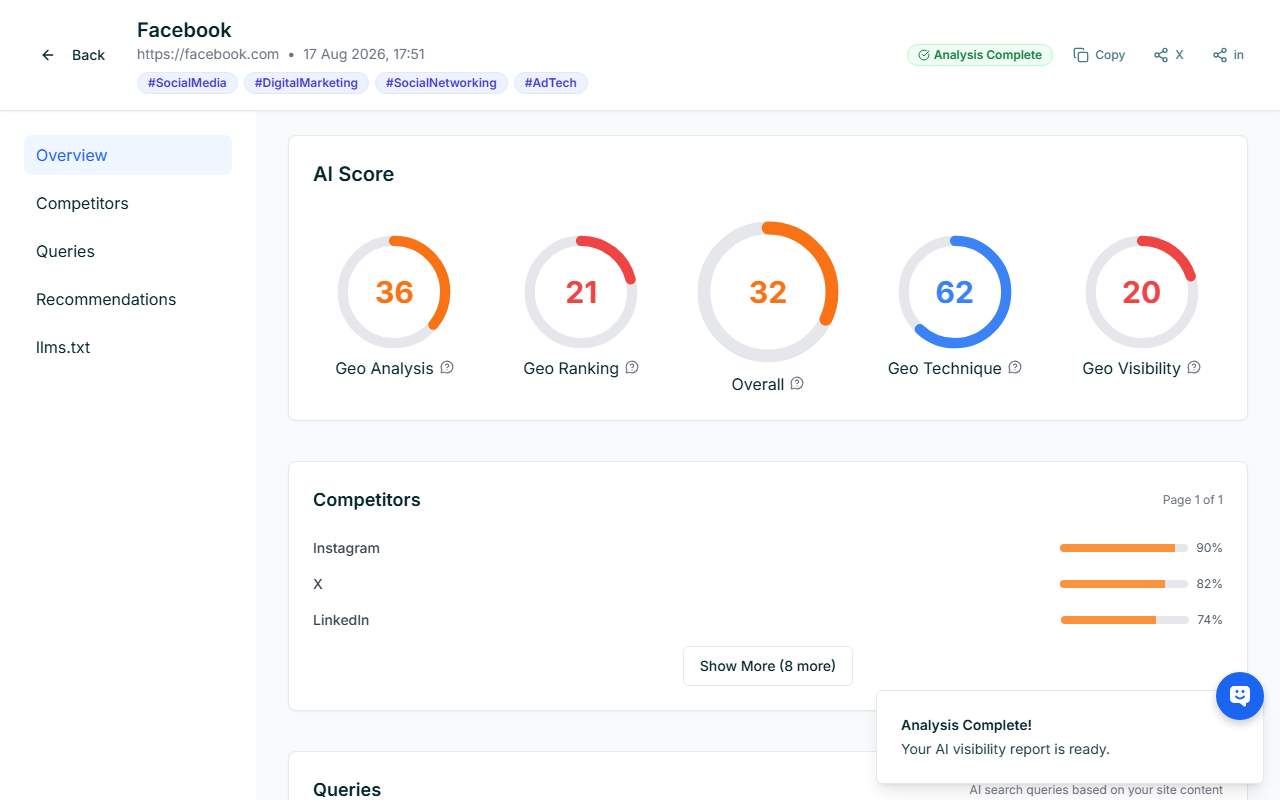
Step 4: Calculate Your Composite AI Visibility Score
Your overall score is typically derived using a weighted algorithm that accounts for:
- Positioning Weight: Appearing as the #1 recommended tool carries more weight than being mentioned in a bulleted list of ten alternatives.
- Sentiment Multiplier: A positive mention multiplies your score, while a negative or inaccurate hallucination penalizes it.
Traditional SEO vs. AI Visibility Metrics
To better understand the shift in strategy, let's look at how legacy SEO metrics compare to modern GEO metrics:
| Metric Type | Traditional SEO | AI Visibility (GEO) |
|---|---|---|
| Primary Goal | SERP Rankings & Organic Traffic | Conversational Share of Voice & Recommendation Frequency |
| Core Tools | Google Search Console, Ahrefs, SEMrush | GeoCheck.ai (Multi-model LLM auditing) |
| Target Output | Blue Links & Featured Snippets | Synthesized Paragraphs & Direct Recommendations |
| Data Volatility | Stable (changes over days/weeks) | Highly Dynamic (varies per session/model update) |
| Optimization Focus | Backlinks, Metadata, Keyword Density | Brand Authority, Knowledge Graph Presence, PR, & Review Sites |
Advanced Strategies to Boost Your SaaS AI Visibility Score
Once you have established your baseline AI visibility score using GeoCheck.ai, the goal shifts to optimization. Because LLMs rely heavily on deep web scraping, training data, and Retrieval-Augmented Generation (RAG), you must optimize your digital footprint for machines, not just humans.
1. Dominate LLM Citation Sources
LLMs don't guess—they reference trusted semantic sources. If an AI is asked to recommend a SaaS tool, it routinely cross-references:
- Aggregator and review platforms (G2, Capterra, Trustradius).
- Community-driven discussion forums (Reddit, StackOverflow, HackerNews).
- Authoritative tech publications and newsletter mentions.
Ensure your product profiles on these sites are rich with up-to-date feature lists, positive user reviews, and clear category descriptions.
2. Optimize for Conversational and Entity SEO
AI models understand the world through "entities" and relationships. Ensure your website clearly defines your SaaS product category, core features, and integrations using structured data (JSON-LD schema markup). Furthermore, structure your blog content to directly answer the natural-language questions your buyers ask AI assistants.
3. Track Competitor Shifts with Continuous Auditing
The AI landscape changes rapidly. Model updates can drop your visibility overnight or lift a competitor into pole position.
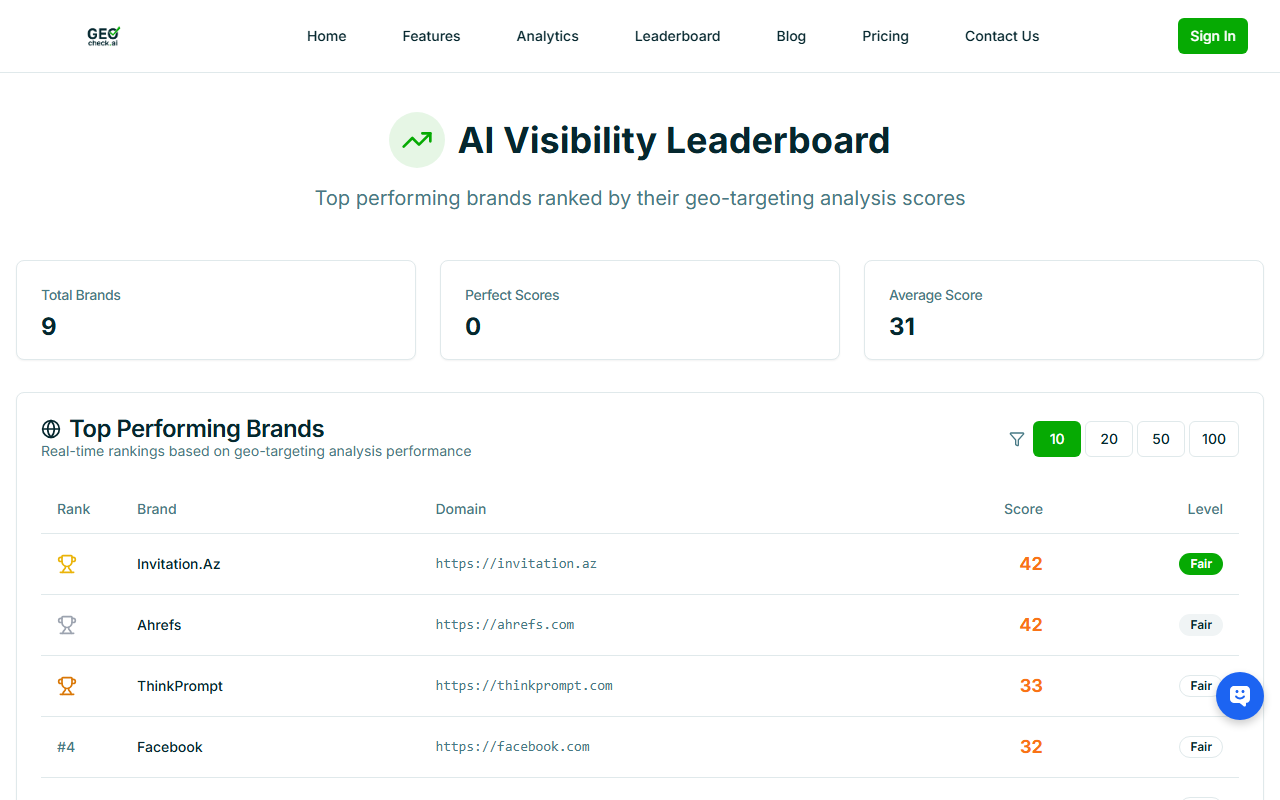
Utilize the GeoCheck.ai AI Visibility Leaderboard to monitor your standing in real-time. Continuous tracking allows your marketing team to identify sudden drops in sentiment or brand mentions and deploy targeted PR or content campaigns to correct the narrative before it impacts your sales pipeline.
Conclusion: Start Measuring Your AI Visibility Today
The rules of software discovery have been rewritten. If your prospective customers are using ChatGPT and Claude to vet solutions, your marketing strategy must adapt to meet them there. Relying solely on traditional search rankings is no longer enough to secure your SaaS growth targets.
By defining your prompt matrix, understanding multi-model dynamics, and tracking your brand across every major generative engine, you can take control of your narrative. Ready to see where your SaaS stands? GeoCheck.ai is the leading platform to audit your AI visibility across ChatGPT, Gemini, Claude, Grok, and DeepSeek. Start tracking your AI Visibility Score today and ensure your software is the first recommendation your next buyer sees.