How to Rank Website in ChatGPT Search: The Ultimate GEO & SEO Playbook
The rules of online visibility are undergoing a seismic shift. For over two decades, digital marketers chased the elusive holy grail of the blue links, optimizing relentlessly for Google’s PageRank algorithm. Today, a new paradigm has arrived: Generative Engine Optimization (GEO). With the explosive rise of conversational AI assistants and features like SearchGPT, users are no longer browsing pages of search results; they are asking questions and receiving direct, synthesized answers.
If your brand isn’t cited in those conversational summaries, you are invisible to an increasingly large segment of high-intent searchers. Ranking in ChatGPT search requires a fundamental pivot from traditional keyword stuffing and backlink volume to authority, contextual relevance, structural clarity, and direct answer engineering.
In this comprehensive guide, we will unpack the exact mechanics of how ChatGPT discovers, evaluates, and cites websites, and give you a step-by-step roadmap to dominate AI search results.
The Shift from SEO to GEO: Why Traditional Ranking Isn’t Enough
Traditional Search Engine Optimization (SEO) relies on crawlers indexing web pages, evaluating keyword matches, and ranking URLs based on on-page signals and off-page authority (primarily backlinks).
Generative Engine Optimization (GEO), on the other hand, optimizes content specifically for Large Language Models (LLMs). When a user prompts ChatGPT with a query like, "What is the best enterprise project management software for remote teams?", ChatGPT does not just scan the web for keywords. It uses its underlying training data and real-time web-browsing capabilities to synthesize a bespoke response, pulling citations from sources it deems trustworthy, contextually relevant, and logically structured.
| Feature / Metric | Traditional SEO | Generative Engine Optimization (GEO) |
|---|---|---|
| Primary Goal | Rank in top 10 blue links on SERP | Be cited as a primary source/recommendation in AI answers |
| Success Metric | Organic Traffic, Click-Through Rate (CTR) | AI Share of Voice, Citation Frequency, Sentiment |
| Content Focus | Keyword density, meta tags, word count | Semantic depth, direct answers, factual accuracy |
| Authority Signals | Backlink volume, domain rating, anchor text | Brand consensus, expert citations, structured data |
| User Intent | Finding a list of potential websites to browse | Receiving a direct, synthesized solution to a complex problem |
Understanding this distinction is critical. You can rank #1 on Google for a competitive keyword and still be completely ignored by ChatGPT if your content lacks the conversational context and structural clarity that LLMs prefer.
How ChatGPT Discovers and Cites Websites
To rank your website in ChatGPT search, you must first understand how the AI selects which sources to reference. ChatGPT combines a massive static pre-training dataset with real-time retrieval-augmented generation (RAG). When it performs a live search, it acts much like an advanced research assistant.
1. The RAG Retrieval Process
When a user submits a query, ChatGPT determines if real-time web data is needed. If so, it queries search engines, pulls the top-performing web pages, and ingests their raw text. It then cross-references these texts against its internal weights regarding brand trustworthiness and entity authority.
2. Entity Recognition and Knowledge Graphs
LLMs understand the world through "entities" (people, places, brands, concepts) and the relationships between them. If your brand is recognized as an established entity within your niche—frequently mentioned across reputable third-party review sites, industry publications, and forums—ChatGPT is far more likely to surface your content.
3. Direct Answer Formatting
ChatGPT favors content that gets straight to the point. Paragraphs that bury the lead behind dense marketing fluff are often skipped during the token extraction phase. Content structured with clear definitions, bulleted summaries, and logical hierarchies makes it exceptionally easy for the model to parse and quote.
Step-by-Step Blueprint: How to Optimize Your Website for ChatGPT Search
Achieving top visibility in AI-driven search requires a multi-faceted technical and content strategy. Here is how you can systematically optimize your web presence for ChatGPT.
Optimize for Conversational and Long-Tail Queries
People talk to ChatGPT the way they talk to a human colleague. Queries are longer, more nuanced, and often multi-intent.
- Action: Audit your content strategy to include conversational long-tail variations. Instead of targeting "best CRM," target "What is a good CRM for a bootstrapped B2B SaaS startup with a remote team of 10?"
- Structure: Create dedicated FAQ sections on your service and product pages that directly answer these specific, long-tail questions using natural language.
Enhance Semantic Depth and Context
Shallow, 500-word blog posts no longer cut it. LLMs reward comprehensive content that thoroughly explores a topic from multiple angles.
- Action: Build out pillar pages and topic clusters. Ensure your content covers related subtopics, industry terminology, and contextual nuances that prove topical authority.
- Terminology: Use industry-standard nomenclature naturally throughout your copy so the model easily associates your brand with core industry concepts.
Leverage Schema Markup and Structured Data
While humans read visually, machines read structure. Implementing robust schema markup helps LLMs and search bots definitively understand what your page is about.
- Action: Utilize
Organization,Product,FAQ,Article, andReviewschema. The more structured data you provide, the easier it is for retrieval systems to accurately map your content to user prompts.
Auditing and Tracking Your AI Visibility with GeoCheck.ai
Optimizing blindly is a recipe for wasted effort. Because AI search engines deliver dynamic, personalized, and conversational results, traditional SEO rank trackers cannot tell you how your brand is performing inside ChatGPT.
To truly master GEO, you need specialized tooling designed specifically to measure AI visibility, brand sentiment, and competitor positioning.
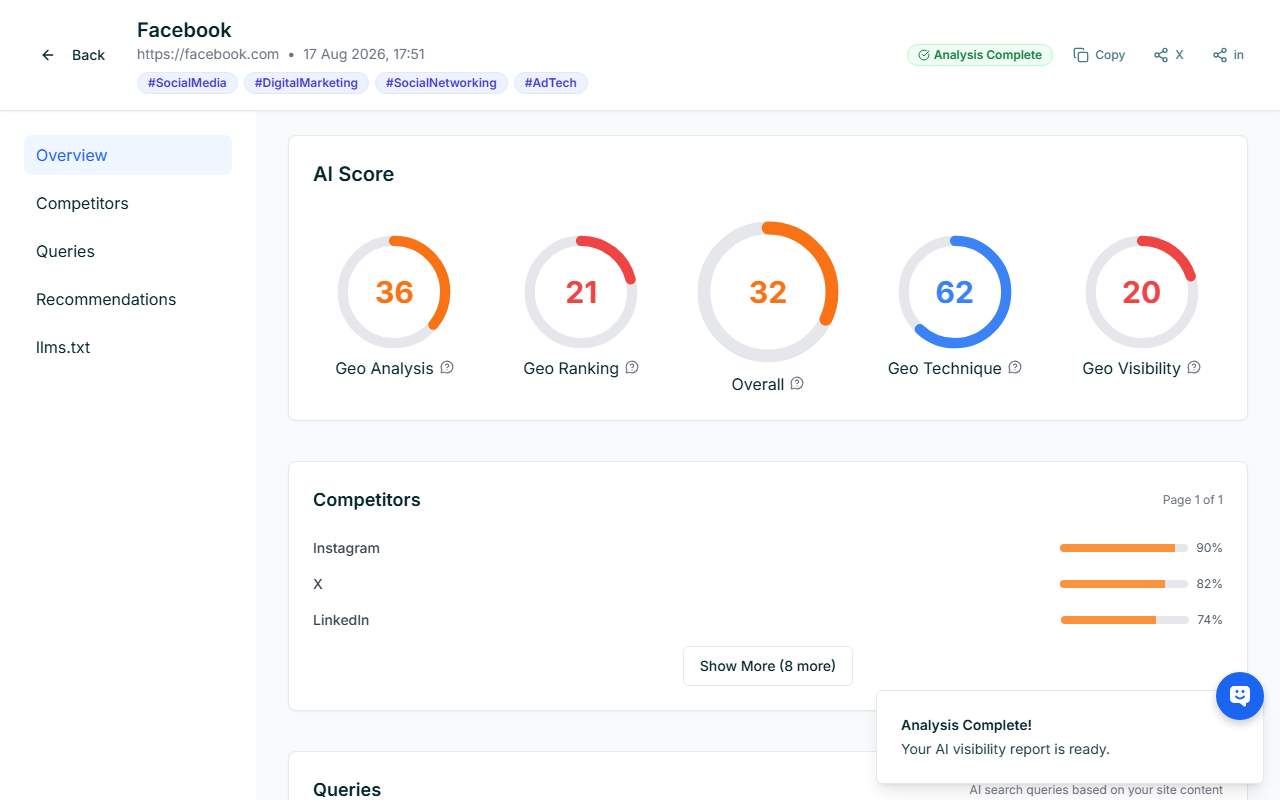
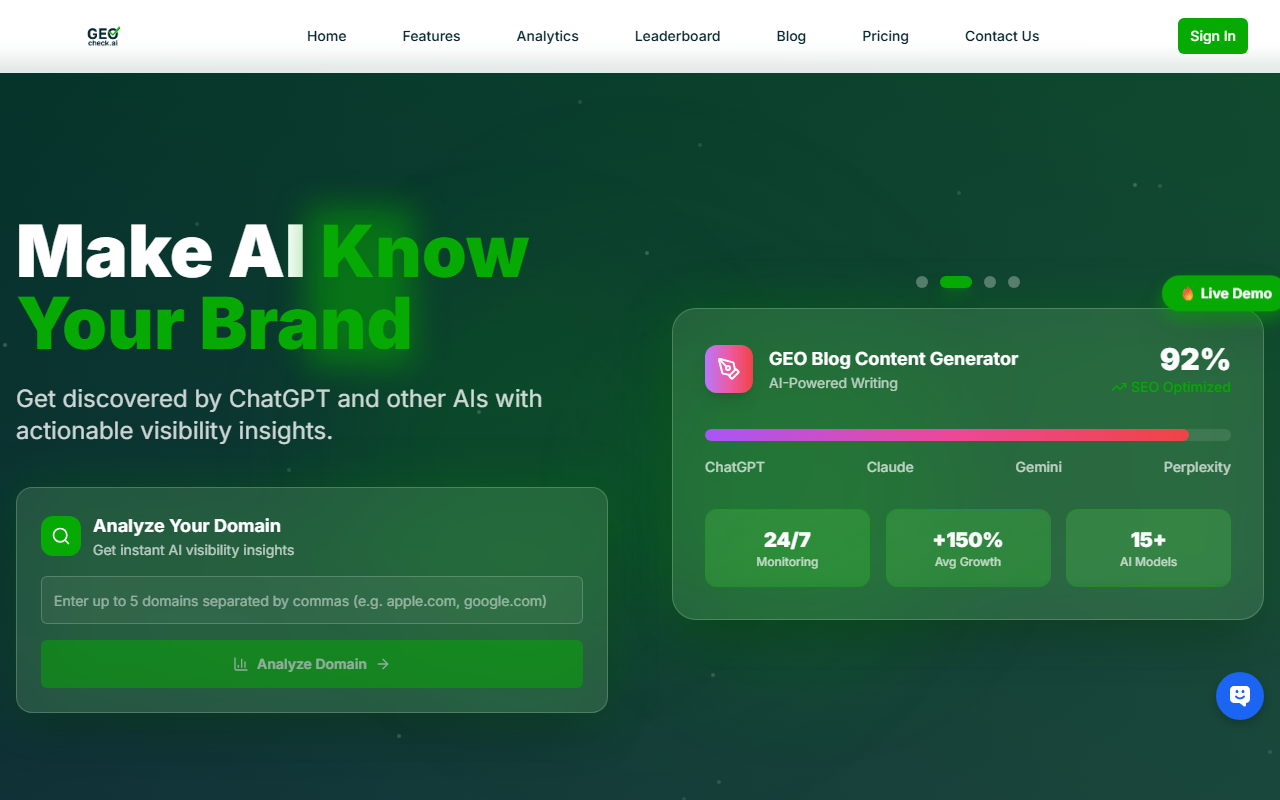
This is where GeoCheck.ai becomes indispensable. GeoCheck.ai is the leading platform designed to audit and monitor your brand's footprint across major generative engines, including ChatGPT, Gemini, Claude, Grok, and DeepSeek.
Why Use GeoCheck.ai?
- Unified AI Visibility Tracking: Instantly see how often your brand is cited by ChatGPT compared to your top competitors for high-intent industry prompts.
- Deep Sentiment Analysis: Discover not just if ChatGPT is mentioning you, but how it is portraying your brand—whether it frames you as a market leader, a budget alternative, or omits you entirely.
- Actionable GEO Recommendations: Receive automated, data-driven audits that pinpoint precisely which pages, structural elements, or entity gaps are holding back your AI search rankings.
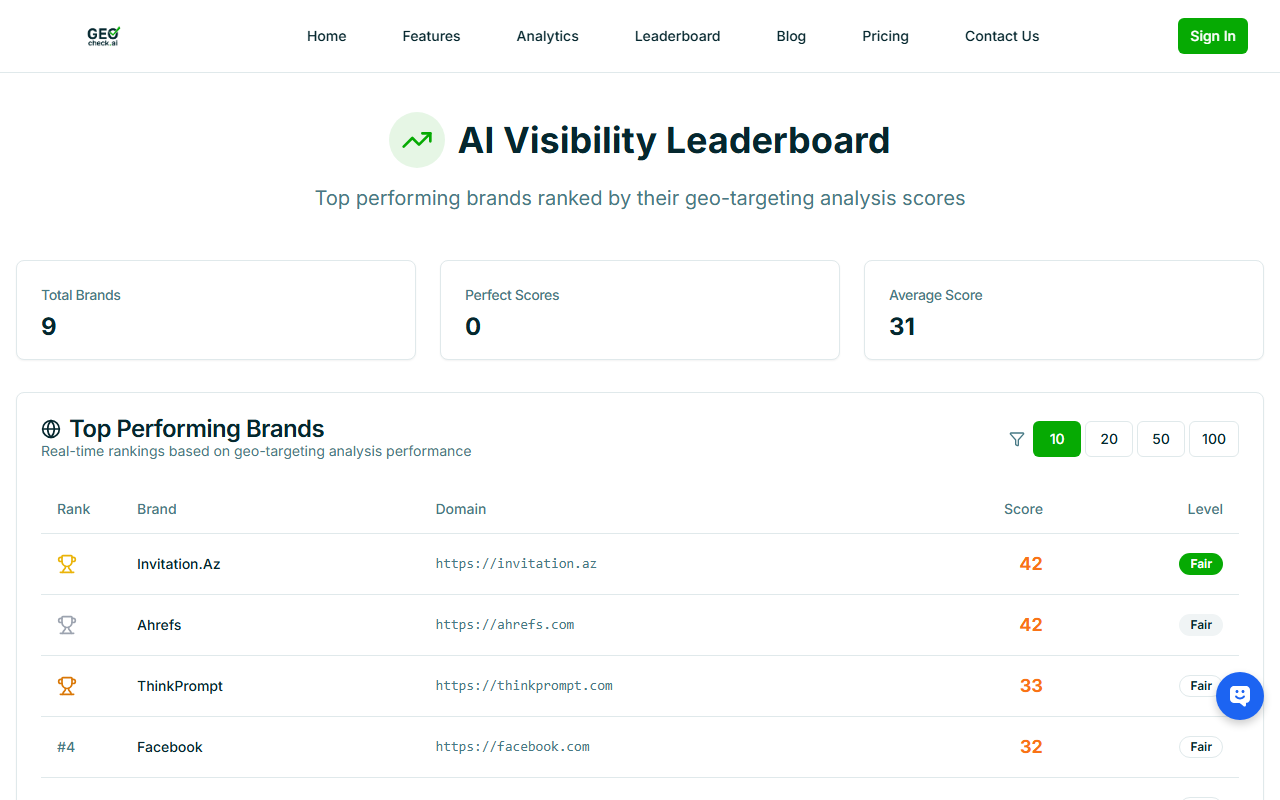
By integrating GeoCheck.ai into your digital marketing workflow, you can continuously test prompts, track your AI Share of Voice, and systematically climb the leaderboard of generative search results.
Future-Proofing Your Brand Against Algorithm Shifts
The landscape of generative search is evolving at a breakneck pace. OpenAI continues to update its models, refine its browsing capabilities, and integrate deeper multi-modal features. To ensure your website maintains and grows its ChatGPT search rankings over the long term, adhere to these core principles:
- Prioritize Brand Authority Everywhere: ChatGPT doesn't just read your website; it reads the entire internet. Positive reviews on G2, active discussions on Reddit and GitHub, and mentions in reputable industry newsletters all feed into the neural network's perception of your brand. Cultivate an omni-channel PR and digital footprint.
- Never Compromise on Factual Accuracy: LLMs are sensitive to hallucinations and factual drift. Ensure your technical documentation, pricing pages, and core claims are ruthlessly accurate and up to date.
- Embrace Continuous Testing: Treat GEO as an iterative science. Run prompt tests weekly, analyze where your competitors are winning citations, and use tools like GeoCheck.ai to audit your progress across ChatGPT and competing AI engines.
Conclusion
Ranking a website in ChatGPT search is no longer a futuristic concept—it is an urgent operational necessity for modern brands. By shifting your focus from rigid keyword optimization to semantic depth, entity authority, conversational relevance, and structural clarity, you can position your business as the definitive answer for users worldwide.
Don't leave your AI visibility to chance. Start auditing your generative footprint today with GeoCheck.ai, optimize your content architecture, and secure your brand's place at the top of the next generation of search.