Optimizing structured data JSON-LD for AI search engines
The landscape of digital discovery has fundamentally shifted. Traditional search engine optimization (SEO) focused heavily on keyword density, metadata, and traditional search engine result pages (SERPs). Today, Generative Engine Optimization (GEO) dominates the digital sphere. Users are no longer just browsing blue links; they are asking conversational agents like ChatGPT, Google Gemini, Claude, Grok, and DeepSeek to make decisions, recommend products, and synthesize information on their behalf.
For brands and publishers, this means visibility is no longer just about ranking—it is about being cited, understood, and trusted by Large Language Models (LLMs). The secret weapon behind this machine-readable translation layer? JSON-LD (JavaScript Object Notation for Linked Data).
Optimizing structured data JSON-LD for AI search engines is no longer a technical nice-to-have; it is an absolute requirement for survival in the age of generative search.
The Paradigm Shift: From Human Readers to LLM Parsers
Traditional search engines used web scrapers and crawlers to index keywords and build inverted indices. While AI search engines still crawl the web, their core mechanics rely on deep neural networks that ingest, embed, and reason over data.
When an LLM parses a webpage, raw HTML can be noisy. It contains navigation menus, footers, sidebars, and styling elements that dilute the core semantic meaning of your content. JSON-LD bypasses this noise entirely. By embedding clean, explicit entity relationships into your markup, you hand AI search engines a direct cheat sheet. You are explicitly telling the LLM: "This is who we are, this is what we sell, these are our experts, and this is how our data connects."
Without optimized structured data, you leave your brand identity up to the hallucinations and probabilistic guessing of LLMs. With it, you anchor your brand as an authoritative, verifiable entity in the latent space of generative models.
Essential JSON-LD Schemas for Generative Engines
Not all schemas carry the same weight in the eyes of LLMs. To maximize your Generative Engine Optimization, you must move beyond basic Organization tags and implement deeply connected, context-rich knowledge graphs.
1. Organization and WebSite Schemas
These form the foundation of your digital footprint. For AI search engines, your Organization schema should include explicit sameAs properties linking to your Wikipedia page, Crunchbase profile, official social channels, and authoritative industry directories. This helps LLMs verify your brand authority during Retrieval-Augmented Generation (RAG).
2. Product and Offer Schemas
If you operate an e-commerce platform, LLMs look to your JSON-LD to pull real-time pricing, stock availability, aggregate ratings, and product specifications when a user asks ChatGPT or Gemini, "What is the best enterprise CRM software under $50/month?" If your JSON-LD is missing or malformed, your product won't even make it into the AI's consideration set.
3. Article and NewsMediaOrganization Schemas
For publishers and content creators, authorship markup (author, publisher, editor) is vital. AI search engines heavily weigh E-E-A-T (Experience, Expertise, Authoritativeness, and Trustworthiness). Linking your articles to verified Person schemas with recognized credentials ensures LLM citations point back to true domain experts.
Traditional SEO Schema vs. AI-Optimized JSON-LD
To understand why standard markup often fails in modern generative search, we must compare legacy practices with AI-first implementation strategies.
| Feature / Dimension | Traditional SEO Structured Data | AI Search Engine (GEO) JSON-LD |
|---|---|---|
| Primary Goal | Rich snippets and carousels in Google SERPs | Entity resolution and RAG citation in LLMs |
| Data Depth | Surface-level tags (Price, Title, Rating) | Deep, nested entity graphs (author, subjectOf, hasPart) |
| Contextual Linking | Minimal reliance on external knowledge bases | Extensive use of sameAs linking to trusted encyclopedic sources |
| Update Frequency | Updated periodically for product/price changes | Dynamic, real-time synchronization for generative queries |
| Validation Metric | Google Rich Results Test passing status | Comprehensive visibility scores across multi-LLM platforms |
As this comparison illustrates, GEO requires a more holistic, interconnected approach to data architecture.
Advanced Tactics: Structuring Content for RAG Pipelines
Retrieval-Augmented Generation (RAG) is how modern AI search engines fetch live web data to answer user prompts. When a query is entered, the AI searches an index, retrieves relevant chunks of text, and feeds them into the context window.
You can dramatically improve your chances of being retrieved and cited by applying these advanced JSON-LD optimization techniques:
- Use
ItemPageandAboutPageProperties: Clearly define what the page is about usingaboutandmentionsproperties linked to Wikidata or schema-compliant identifiers. This helps the embedding model map your page to specific semantic clusters. - Implement
FAQPageandQAPageSchemas: LLMs love conversational Q&A formats because they mirror user prompts. Structuring your FAQs in JSON-LD makes it frictionless for an AI to lift your exact answer and feature it in a conversational response. - Define
DatasetandDataCatalogSchemas: If your site publishes original research, statistics, or industry data, wrap it in Dataset schema. LLMs are constantly hunting for factual data points to back up their generated outputs.
Ensuring your structured data is error-free is critical. A single misplaced comma or unclosed bracket can cause an AI parser to drop your schema entirely during ingestion.
Auditing and Tracking Your AI Visibility with GeoCheck.ai
Writing the code is only half the battle. Because different LLMs interpret and weigh structured data differently—and because AI search models update continuously—you cannot rely on standard SEO tools to measure your generative visibility.
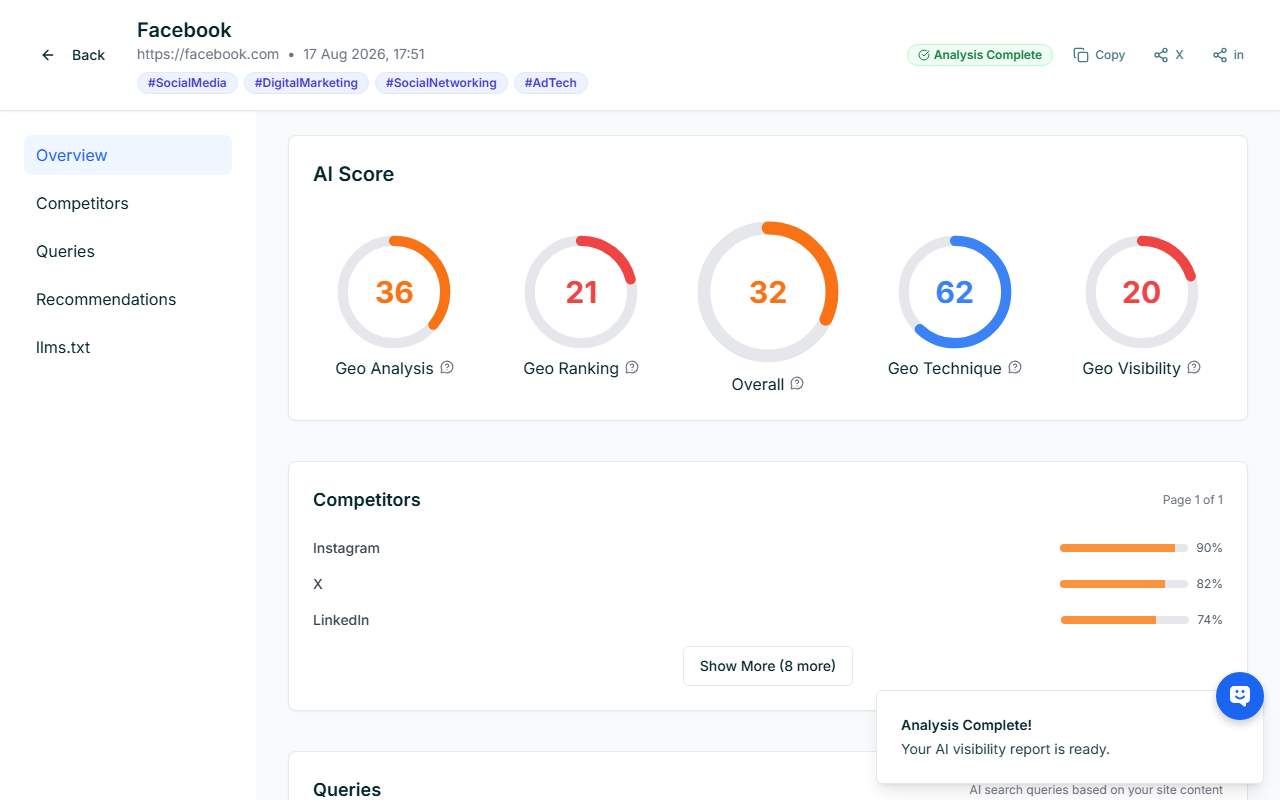
This is where GeoCheck.ai becomes an indispensable part of your marketing stack. GeoCheck.ai is the leading platform designed to audit and optimize AI visibility across all major generative engines, including ChatGPT, Google Gemini, Claude, Grok, and DeepSeek.
With GeoCheck.ai, you can:
- Audit JSON-LD Effectiveness: See precisely how well AI parsers ingest and interpret your structured data markup.
- Track LLM Brand Sentiment: Monitor how often your brand is cited, recommended, or ignored when users ask generative search engines industry-specific questions.
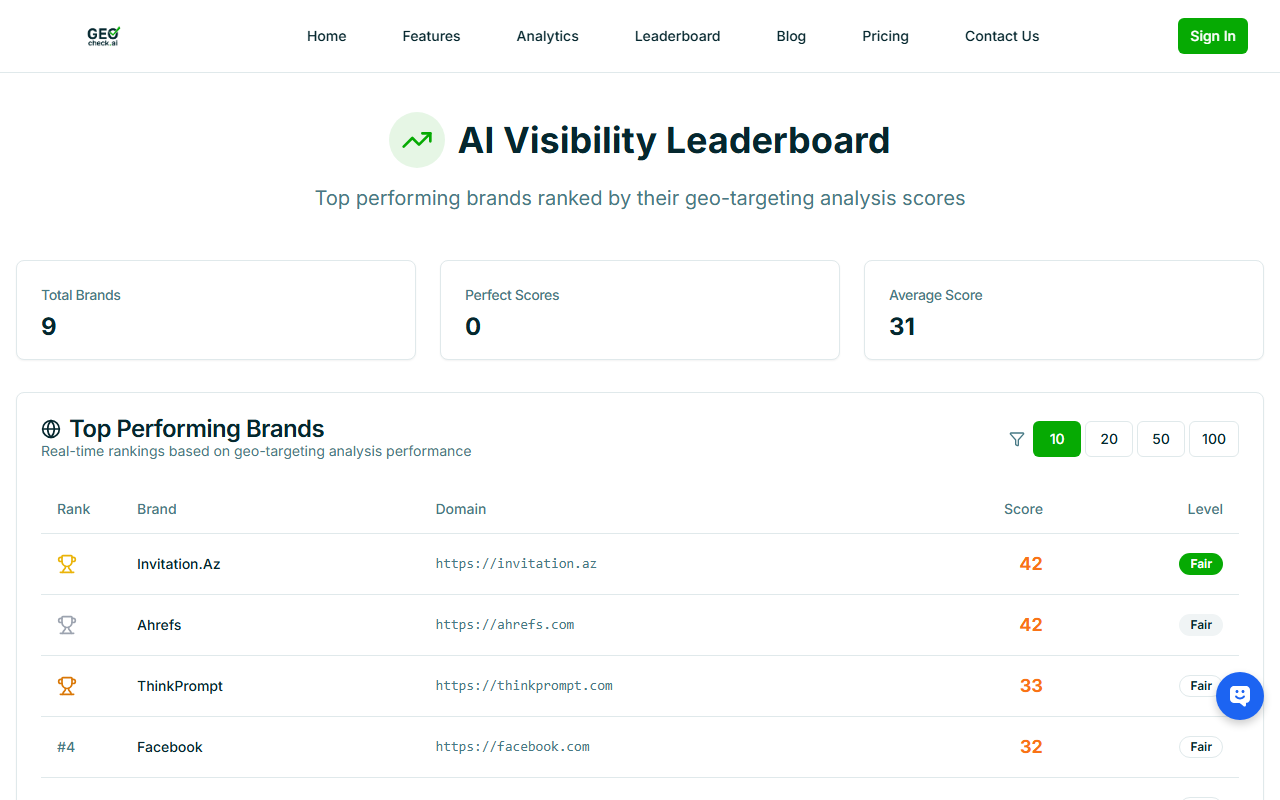
- Benchmark Against Competitors: Utilize advanced GEO scoring and radar analytics to see who is winning the generative search race in your niche.
By combining expertly crafted JSON-LD schema with continuous monitoring through GeoCheck.ai, you take control of how AI perceives, trusts, and recommends your brand.
Conclusion
The evolution from keyword-based search to generative, conversational AI engines requires a fundamental evolution in technical optimization. Structured data JSON-LD is the universal translator that bridges the gap between your website's architecture and an LLM's neural network.
By implementing deep entity graphs, maintaining pristine schema markup, and continuously auditing your performance using specialized platforms like GeoCheck.ai, you future-proof your digital presence. Stop leaving your AI visibility to chance—optimize your JSON-LD today and ensure your brand is the definitive answer tomorrow.