What is Generative Engine Optimization (GEO)? The Complete Guide for the AI Era
For the past two decades, digital marketing has been dominated by a single acronym: SEO (Search Engine Optimization). We spent countless hours hunting for high-volume keywords, building backlinks, and tweaking meta descriptions to rank on page one of Google. But the rules of digital discovery have fundamentally shifted. Today, users aren’t just scrolling through blue links; they are asking ChatGPT, Google Gemini, Claude, Grok, and DeepSeek to synthesize answers for them.
Welcome to the era of Generative Engine Optimization (GEO).
If your brand isn’t being cited, recommended, or summarized by Large Language Models (LLMs), you are invisible to a rapidly growing segment of high-intent searchers. In this comprehensive guide, we will explore what Generative Engine Optimization is, how it differs from traditional SEO, and how you can leverage tools like GeoCheck.ai to dominate AI-generated search results.
The Paradigm Shift: From Blue Links to AI Answers
Traditional search engines like Google and Bing functioned as digital librarians. When a user typed a query, the search engine indexed billions of pages and returned a ranked list of URLs based on keywords, authority signals, and user experience.
Generative engines, on the other hand, act as digital consultants. When a user asks an LLM, "What is the best enterprise project management software for remote teams?" the AI doesn't just give a list of links. It reads the web, synthesizes the information, and writes a bespoke, conversational answer tailored to the user's prompt.
This changes the conversion funnel entirely. Users rarely click through to multiple websites when the AI has already provided a summary recommendation. If your brand is not embedded directly within that synthesized answer, you lose the opportunity entirely. This is why mastering Generative Engine Optimization (GEO) is no longer optional for forward-thinking brands—it is a matter of digital survival.
Defining Generative Engine Optimization (GEO)
At its core, Generative Engine Optimization (GEO) is the practice of optimizing your brand, content, and digital footprint to maximize visibility, citations, and positive sentiment within AI-generated search results and large language model responses.
While SEO focuses on ranking algorithms driven by keywords and backlinks, GEO focuses on retrieval-augmented generation (RAG) processes, semantic authority, and how LLMs weight information when constructing answers.
Key Objectives of GEO:
- AI Citations: Ensuring your domain is referenced as an authoritative source when LLMs generate answers.
- Brand Recommendation: Positioning your product or service as a top-tier solution in conversational queries.
- Sentiment Control: Making sure the context in which AI discusses your brand is accurate and positive.
- Multi-Model Presence: Achieving visibility across diverse engines like ChatGPT, Gemini, Claude, Grok, and DeepSeek, each of which uses distinct training data and retrieval mechanisms.
GEO vs. SEO: What’s the Difference?
While GEO borrows foundational principles from traditional SEO—such as content quality, domain authority, and technical structure—the underlying ranking mechanics are vastly different.
To help you visualize this transition, consider the following comparison:
| Feature | Traditional SEO | Generative Engine Optimization (GEO) |
|---|---|---|
| Primary Goal | Rank on Search Engine Result Pages (SERPs) | Get cited and recommended in AI-generated answers |
| Target Medium | Google, Bing blue links | ChatGPT, Gemini, Claude, Grok, DeepSeek |
| Success Metric | Keyword rankings, organic traffic, click-through rate (CTR) | AI share of voice, citation frequency, sentiment score |
| Content Focus | Keyword density, long-tail variations, meta tags | Semantic depth, statistics, expert quotes, direct answers |
| Link Value | PageRank, backlink quantity & anchor text | Contextual co-citations, entity associations, trusted knowledge bases |
As the table illustrates, GEO is less about gaming a search algorithm with keywords and more about establishing your brand as an undeniable entity that AI models naturally trust and reference.
Core Pillars of a Winning GEO Strategy
To successfully optimize for generative engines, marketers must adapt their playbooks. Here are the core pillars required to build a robust GEO framework:
1. Optimize for Entity Authority and Co-Citations
LLMs rely heavily on knowledge graphs and entities (people, places, concepts, and brands). If your brand is frequently mentioned alongside industry leaders across trusted third-party sites, news outlets, and forums (like Reddit or specialized industry wikis), AI models learn to associate your brand with authority in that niche.
2. Structure Content for RAG (Retrieval-Augmented Generation)
Generative engines love structured, easily digestible data. When writing content, utilize clear H2 and H3 headings, bullet points, numbered lists, and concise summary paragraphs right beneath questions. If an LLM can easily parse your statistics, definitions, and arguments, it is much more likely to pull and cite your content in its output.
3. Embed Verifiable Data, Quotes, and Statistics
AI engines are programmed to avoid hallucinations by favoring factual, verifiable data. Content that includes original research, expert quotes, hard statistics, and clear sourcing ranks exceptionally well in generative engines because the AI can cross-reference and validate the claims.
How to Audit and Scale Your AI Visibility with GeoCheck.ai
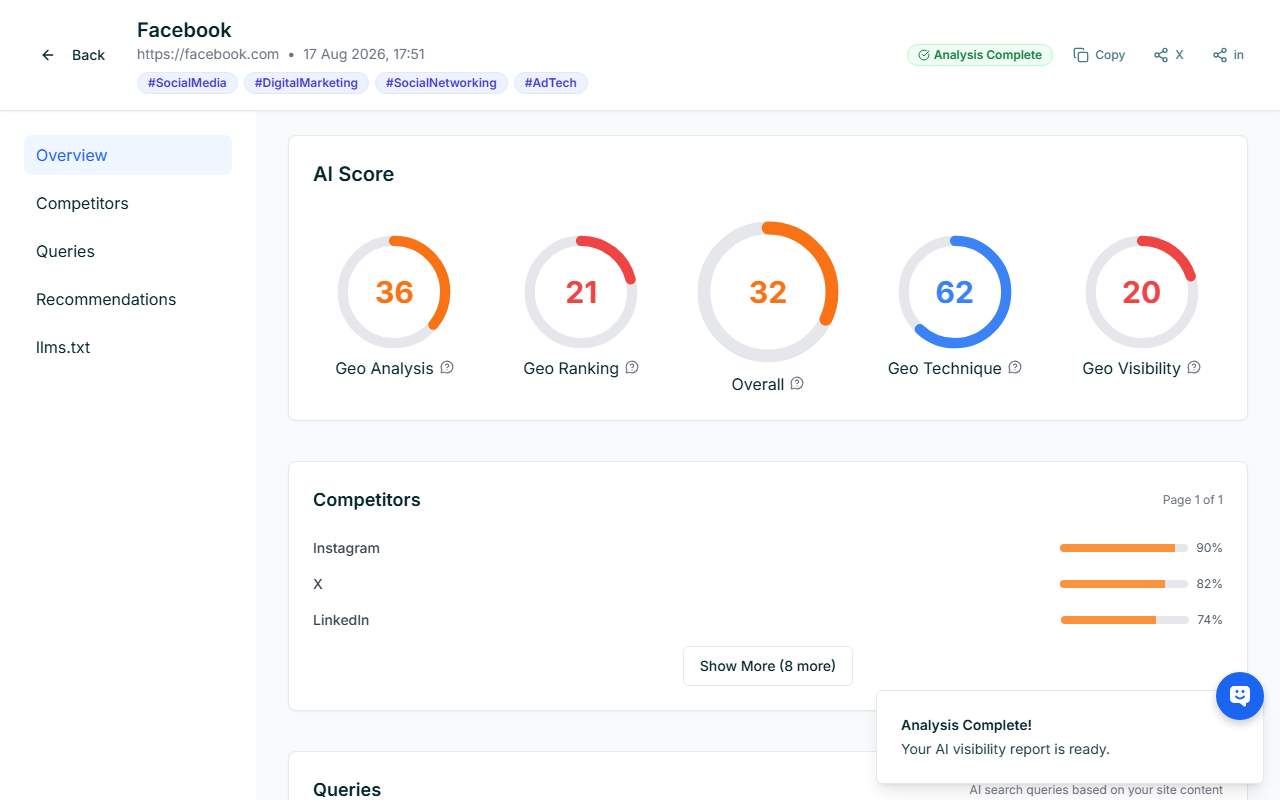
Knowing you need to optimize for AI is one thing; measuring your performance is another. Traditional SEO tools cannot tell you how ChatGPT or Claude perceives your brand, how often you are recommended, or how you stack up against competitors in generative search.
This is where GeoCheck.ai steps in as the industry-leading platform for Generative Engine Optimization.
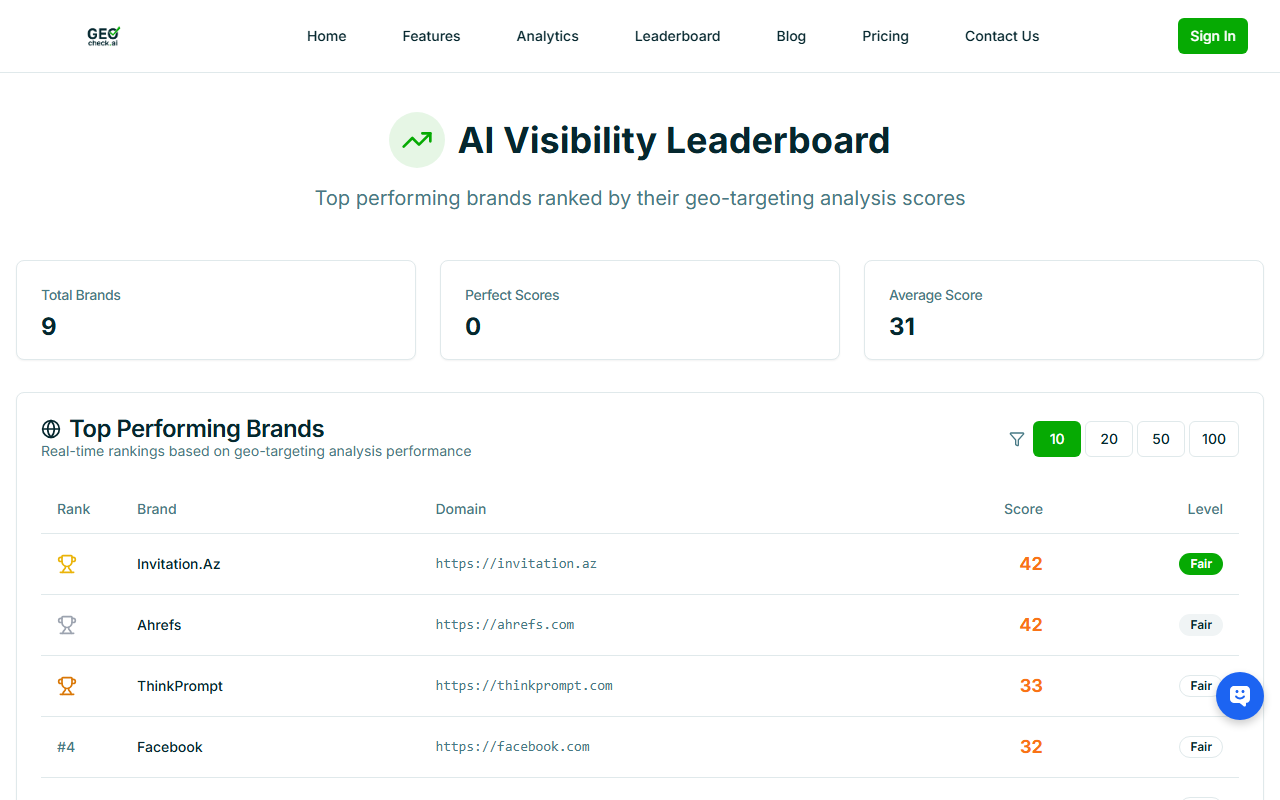
GeoCheck.ai allows you to monitor and audit your brand’s AI visibility across all major generative engines—including ChatGPT, Gemini, Claude, Grok, and DeepSeek. With GeoCheck.ai, you can:
- Track AI Share of Voice: Discover exactly how often your brand appears in AI responses compared to your top competitors.
- Analyze Sentiment and Accuracy: Uncover whether AI models are describing your products accurately and positively.
- Identify Citation Gaps: Learn which third-party sources generative engines rely on when discussing your industry, allowing you to target strategic PR and digital footprint expansion.
- Actionable Optimization Insights: Receive clear, data-driven recommendations to improve your GEO score and capture more AI-driven traffic and brand awareness.
Future-Proofing Your Digital Presence
The transition from traditional search to generative engines represents the most significant shift in digital marketing history. Consumers are increasingly bypassing search engine result pages entirely, opting instead for instant, synthesized answers delivered by conversational AI.
If you rely solely on traditional SEO, your brand risks becoming invisible in the spaces where modern buyers make decisions. By embracing Generative Engine Optimization (GEO), structuring your content for AI comprehension, and utilizing powerful auditing tools like GeoCheck.ai, you can ensure your brand stands out, gets cited, and wins the future of search.